“Everybody comes to Hollywood, they want to make it in the neighborhood,” sings Madonna in her 2003 single “Hollywood.” Last year, Ryan Murphy, the famed television producer behind numerous acclaimed TV series including “Glee,” “Nip/Tuck,” and “American Horror Story,” inked a 9-figure deal with Netflix to create original projects. The latest in Murphy’s pantheon of TV shows is “Hollywood,” a retelling of Tinseltown’s golden era in post-WWII America.
One of the best parts of any period piece is the fashion. Seeing how people dressed in different eras always adds an extra layer to production value beyond that of the actors’ performances and the set design. Fashion Reverie spoke with “Hollywood” costume designers Lou Eyrich and Sarah Evelyn about working with Murphy and recreating 1940s fashion for this new series.
Fashion Reverie: How many Ryan Murphy shows have you costumed so far?
Sarah Evelyn: Lou and I worked on two seasons of “American Horror Story” together, specifically “American Horror Story: Hotel” and “American Horror Story: Cult.” Lou usually works with the co-designers of the TV shows, so Ryan only has one main costume designer he’s working with.
FR: How was the team effort for both of you?
Lou Eyrich: I’ve been with Ryan for 20 years since “Popular.” I have costumed “Niptuck,” “Glee,” and “American Horror Story.” I hitched onto his star early on and did not let go. Ryan’s really made my career, so I’m forever grateful to him. I just love his genius mind, it’s exciting to work with him. When we started working on three to four shows at a time, it was becoming too much for me to handle by myself. So, we decided I’d start costuming the show from the beginning, get the designers up and running, and move onto the next project. At the time, we were taking assistant designers and promoting them to lead designers to keep the flow going. It got to the point where there were so many shows being produced, we were running out of assistants.
Sarah came in, and she had been a stylist for the promotional posters, advertisements, and video clips for “American Horror Story.” I brought her on “American Horror Story: Hotel” to help costume Lady Gaga’s character. I loved her style and work ethic and it mixed in well with our TV world. When we needed a designer for “American Horror Story: Cult,” she did a fantastic job. When I asked her about “Hollywood,” she had just finished “Fast and the Furious: Hobbs and Shaw,” and wanted to stay in town to try working on a period piece. It was perfect timing.
Sarah started working on the costumes for “Hollywood” and we worked together to get the tone of the show right. We met with Ryan and he had a very strong view of each character—the color palette, the set, the locations, and even a list of movies to watch, books to get, and fashion designers from the ‘40s for inspiration.
Sarah Evelyn: Ryan and Lou meet, and they refined the vision for the show. They have a language between them, and it’s great, because then Lou gets the co-designer involved. You have her wealth of 20 years’ experience with Ryan. She knows what he likes, and it seems like sometimes they don’t even need words. Getting to work with Ryan is incredible; getting to work with Lou via Ryan is also incredible. Creativity and the look of the show are always a number one priority. Everything it set up so you can maximize the visual level of the show. You have to build trust with someone. Lou and I are very like-minded and getting to create with Lou is super special. If you have a problem, Lou is the person that gets to help you think through how to solve it, and that’s so important.
FR: What types of references did you use to stay true to the period of the 1940’s?
Sarah Evelyn: Ryan came to us and said, “The Golden Age of Hollywood.” He had some movies he really liked. We watched so many movies. We put photos of the ‘40s images and fabulous outfits we loved all over our office space. We wanted to have like a 1940s Instagram feed office. We also looked for behind the scenes material.
We looked at this great book called Jean Howard’s Hollywood which showed the behind the scenes of Hollywood back then. We hired a fashion historian in New York who brought written resources to us. Back in the ‘40s, so many of things weren’t photographed or were photographed in black and white, so she helped us figure out how those things should look.
FR: What movies did you all watch for inspiration?
Lou Eyrich: I have watched “Woman of the Year,”, “Laura” “The Fleet’s In,” and “His Girl Friday.” There were also an endless number of movies with great fashion.
FR: Were there particular people you modeled any of the actors looks after?
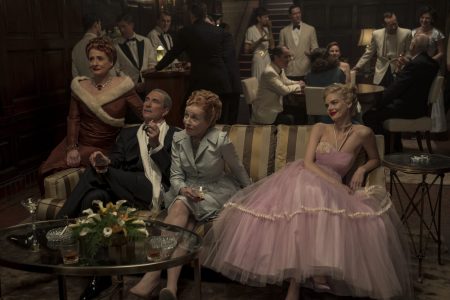
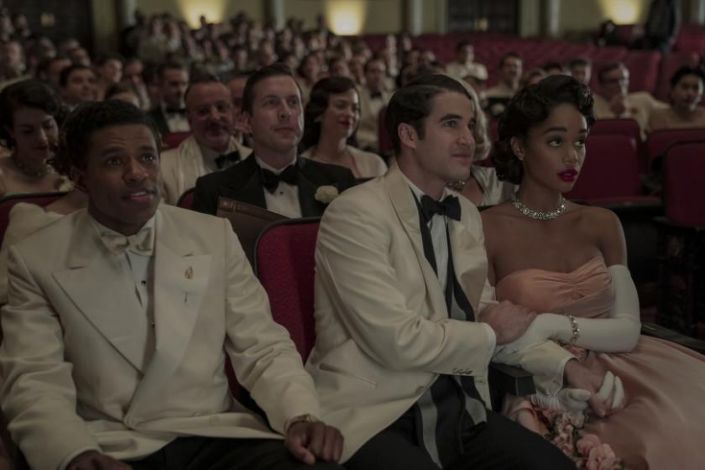
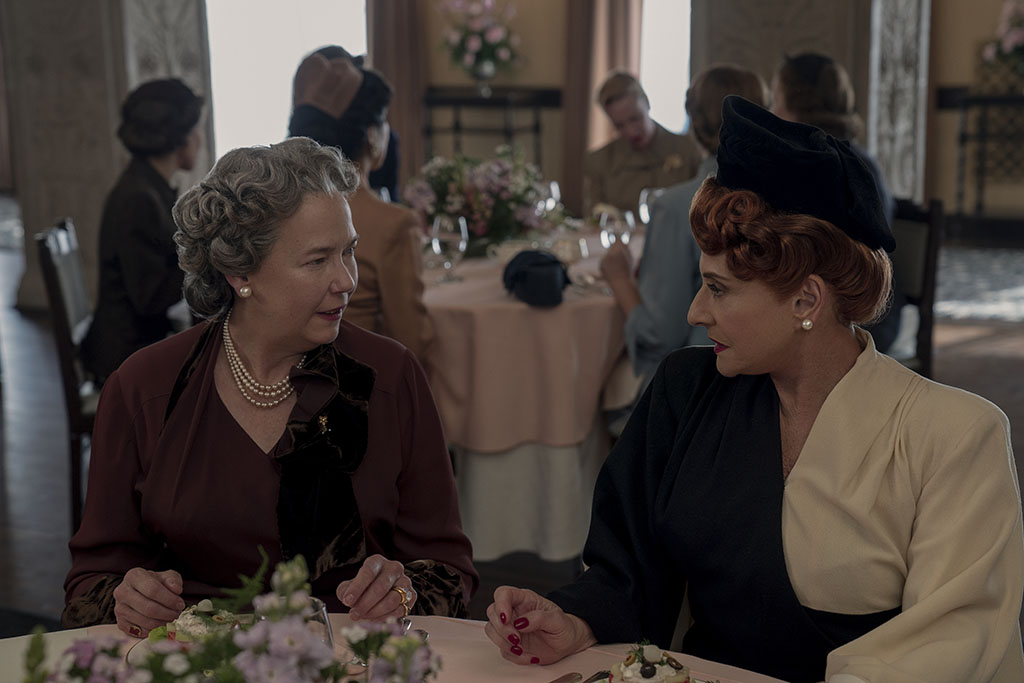
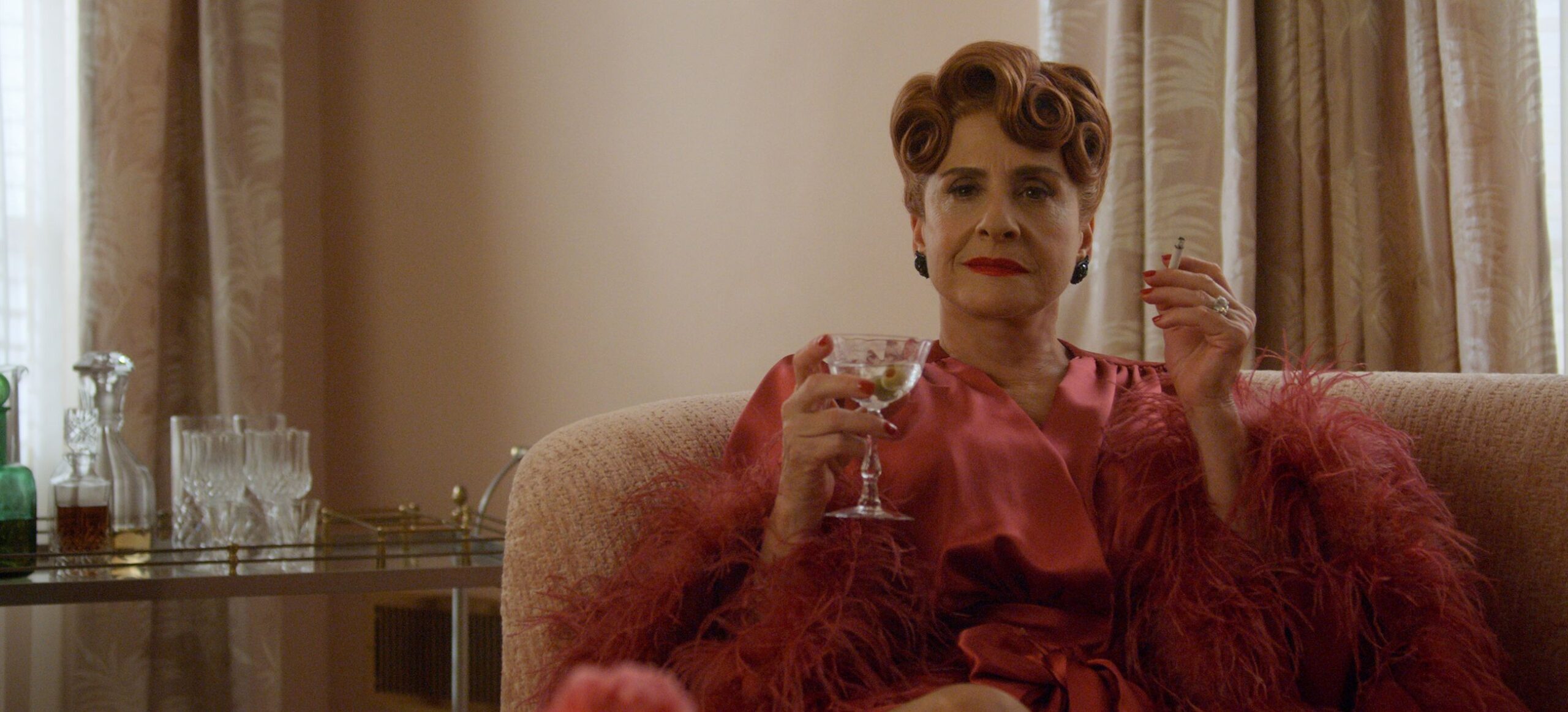
Sarah Evelyn: Patti LuPone was very Joan Crawford and Barbara Stanwyck. With her and her character we did a lot of the risky, glamorous stuff. Holland Taylor was very Marlene Dietrich with the restrained, tailored, menswear-inspired pieces. Holland also brought us a picture of her mom who had very fabulous style, so her mother became an inspiration for her character’s style. Laura Harrier was very Lauren Bacall. Samara Weaving was a young Marilyn Monroe and Ava Gardner type. Jake Picking, who played Rock Hudson, was obviously Rock Hudson. Jeremy Pope was our jazz baby who had his own style. David Corenswet was a young James Dean. Michelle Krusiec who played Anna Mae Wong was obviously Anna Mae Wong, and we were inspired by her 1930s style. Mira Sorvino was more of a Lana Turner type. Dylan McDermott was our Cary Grant and Fred Astaire.
FR: How do you dress characters who are a rewrite of history?
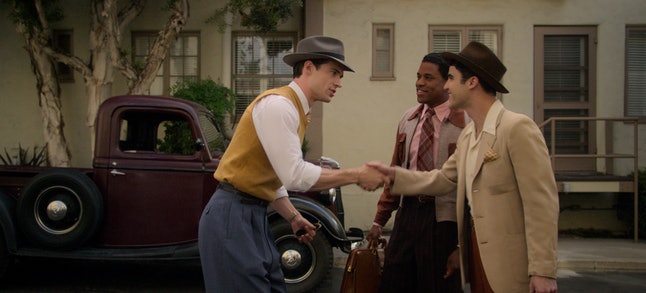
Sarah Evelyn: For me, it really starts with the character. I ask myself where would this person hang out, what would they have seen? Jeremy Pope’s character Archie is a good example. He’s an African American in the 1940s who’s a writer. He’s an artist who’s going to blaze his own path. Laura Harrier’s character Camille is the ‘It Girl.’ She would’ve been blazing her own path. She would’ve been doing things differently, including her fashion sense. That’s why she wears pants.
Lou Eyrich: Ian Brennan, Janet Mock, and Ryan Murphy were the writers. Often in the script there would be a description of how the character should present themselves.
FR: Did you source actual vintage garments or recreate garments?
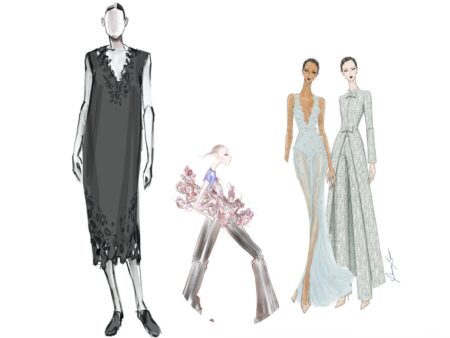
Sarah Evelyn: We did both. We created a lot of pieces, and we definitely sourced from vintage vendors and went to costume houses. There aren’t that many ‘40s clothes, and men didn’t work out in the forties, so that didn’t leave us with many vintage options. During production of the show there were so many other period productions happening at the time, so we were competing with Europe for clothing. Lou has a special relationship with a lot of vintage and costume vendors, so we were able to call in favors. We probably ended up making 50 to 60 percent of the costumes for the principal characters.
FR: What were the challenges of dressing the series’ actors in 1940s clothing?
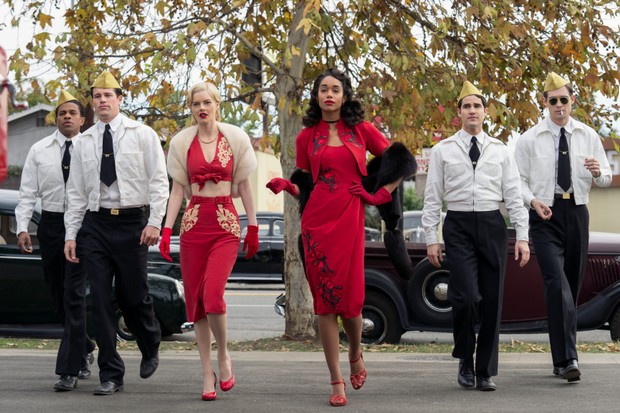
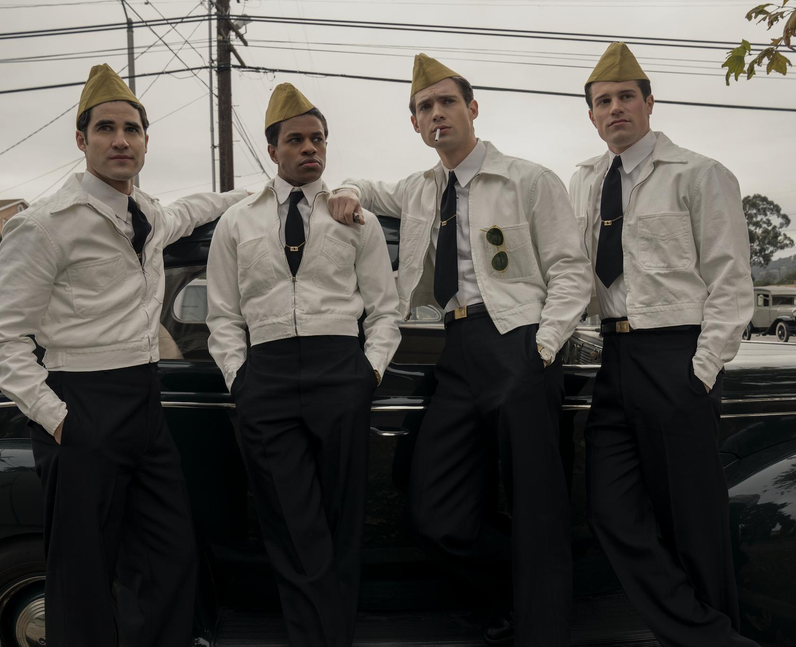
Sarah Evelyn: The cast was amazing. They were so generous and giving and so excited about the costumes. However, 1940s clothes were made for 1940s bodies. People were smaller in the 1940s. This is one reason we needed to create a lot of costumes versus shopping vintage. To make David Corenswet look like a young James Dean, his suit had to hang like he was young James Dean. With the punk jockey uniforms, we had to figure out how to make high-waist, high-leg pants fit the guys and look sexy. We had a whole series of waist and body proportion fittings .
Lou Eyrich: None of the shirts and pants were long enough. The average shoe size in the 1940s was a 6, now average the average women is a 9. We couldn’t use any vintage shoes, they were too small and narrow, plus by now the shoes were in a decayed state. Those were the most basic challenges. The hair department did a fantastic job with the wigs, but sometimes the female casts wigs didn’t fit with the hats, which was something we didn’t think of.
FR: Who was your favorite character to dress?
Sarah Evelyn: Not fair; that’s like asking me to pick a favorite child. Dressing Patti LuPone’s character was a once-in-a-lifetime dream. Working with Patti LuPone was a bucket list dream for me. That said, I don’t really have a favorite.
FR: What costume piece was your favorite?
Lou Eyrich: The pump jockey uniforms that were worn at the gas station with the character of Ernie played by Dylan McDermott were my favorite. When Sarah and I were working during prep we met with Matthew Ferguson, who was the production designer for “Hollywood.” Matthew Ferguson had worked on getting the right feel for the gas station and had gotten Ryan’s approval on the gas station. Together, we decided on white uniforms that had this super clean vibe.
Fitting all the pump jockey uniforms was fun, particularly sourcing the fabrics, buttons, tie chains, and belt buckles and see everything come together. That whole process was fun as opposed to just having one favorite outfit.
FR: What was the greatest challenge in costuming this film?
Sarah Evelyn: One of the challenges of working on a television season with high production value is timing and turnaround, and creating beautiful, cinematic garments on that tight turnaround schedule. You can get any custom-made piece done right if you have two weeks to do it, but two days is tough.
We are lucky to have had had an incredible team. This system with Lou works so well because as a member of the Lou and Ryan Murphy team, you can access the best resources and call in favors.
FR: How close do you all work with Ryan Murphy for final selection of costumes?
Lou Eyrich: Ryan has a 200% final say in the costumes. If a character is cast at 4 pm one day, Sarah is fitting them the next morning. Then, the tailor will fit the actor while they are in the hair and makeup chair, then pictures of the looks are sent to Ryan.
You can binge season one of “Hollywood” currently on Netflix. More of Lou Eyrich’s costuming work can be seen later this year in Ryan Murphy’s upcoming projects “Ratched” and “Boys in the Band.”
—Kristopher Fraser
Image credits
- hollywood-02.jpg — Editorial image.
- hollywood-03.jpg — Editorial image.
- hollywood-08.jpg — Editorial image.
- hollywood-07.jpg — Editorial image.
- hollywood-06-png.jpg — Editorial image.
- hollywood-05.png — Editorial image.
- hollywood-feature.jpg — Editorial image.
Reader Discussion
Start the Conversation
Thoughtful comments, questions, and fashion conversation from Fashion Reverie readers.
Reader Guidelines
Keep the conversation thoughtful, relevant, and respectful. Comments may be moderated before appearing on Fashion Reverie.
No comments yet. Start the conversation with a thoughtful note or question.